
For forty years, Europe has been competing with the major powers, particularly in terms of commercial space launch. Back to the adventure of Arianespace.
For forty years, Europe has been competing with the major powers, particularly in terms of commercial space launch. Back to the adventure of Arianespace.
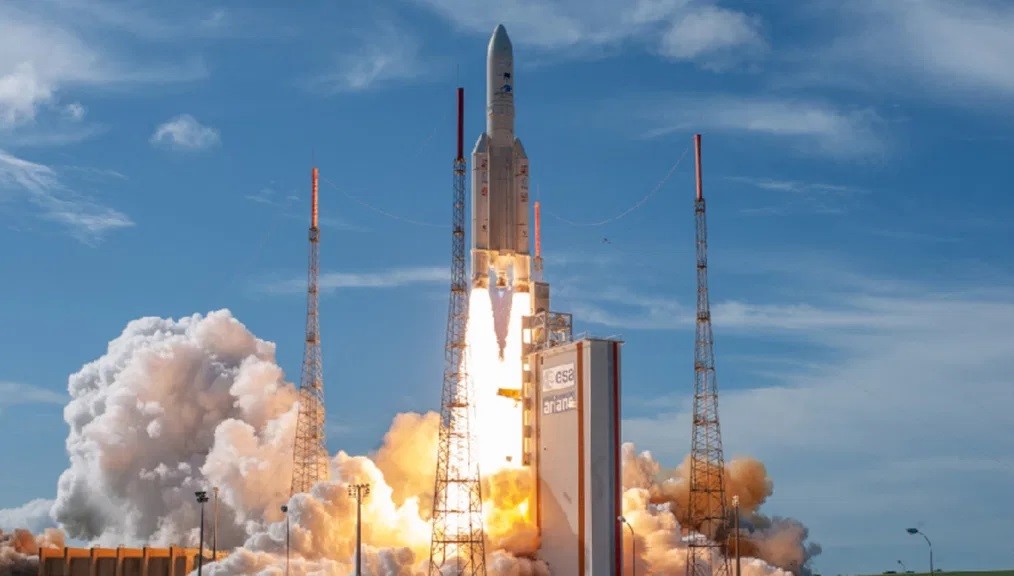
On 6 August 2019, from Kourou, Guyana, the 249th Ariane 5 launch vehicle placed in orbit Intelsat 39 and EDRS-C/Hylas 3, two satellites intended for telecommunications for the first and for the second, data transmission in environmental monitoring and security services.
This new success is a continuation of 40 years of close cooperation between some 40 companies, 12 European States (France, Germany, Italy, Belgium, Spain, Netherlands, Sweden, Switzerland, Norway, Austria, Denmark, Ireland) and the National Centre for Space Studies (Cnes).
In 1973, the French laboratory proposed to its partners to develop a launch vehicle (or rocket) for satellites capable of placing a 1.8 tonne load in geostationary orbit1. On 24 December 1979, Ariane’s first shot was successful, ensuring Europe’s independence for access to space.
On 19 October 1983, the Ariane rocket placed a satellite in orbit for the Intelsat company. This is a revolution: until then, only space agencies were responsible for the production and launch of satellites. The match with the shuttles will be really – and tragically – won only with the drama of January 28, 1986, when the space shuttle Challenger explodes live shortly after its launch. The tragedy killed seven people and justified Europe’s decision to launch commercial satellites using a “traditional” launch vehicle that does not require crew.
4.9 Tonnes in orbit
During the 2000s, the commercial market narrowed as a result of technological advances that extended the life of satellites. Ariane 5 is becoming too expensive and less and less adapted to the satellite market.
In addition, competition is diversifying with the arrival of China, which is capturing part of the market thanks to new reliable and efficient Long Walk launchers. Finally, in the United States, companies like Space X and Blue Origin are revolutionizing space transport.
In order to remain competitive, Arianespace decided in 2014 to launch the Ariane 6 programme, which is more flexible and cheaper than Ariane 5, and is operational in 2020. From the first Ariane 1 to the next Ariane 6, space Europe, under the impetus of France, has demonstrated its capacity for innovation and adaptation to globalisation.
 Go French